When certainty is the absolute command, censorship is the predictable consequence. Oh, how many women have been burned and men guillotined in certainty’s punitive name. It’s an old story with new twists.
Think of it: Surprisingly few, if any, works on the First Amendment have studiously explored the relation between free speech and certainty. The same holds true for decisional law. While this relationship is inherent in much free speech theory and doctrine, its treatment has, nonetheless, been rather opaque. If one were to tease out — philosophically, textually, and operationally — the significance of that relationship, what would it mean for our First Amendment jurisprudence?
‘And yet it moves’
In some vital ways, the First Amendment works to counter self-righteous claims of certainty. It is likewise employed to demand a degree of certainty from those who wish to cabin free speech rights. What follows draws on the words quoted immediately above — words purportedly spoken by Galileo Galilei when he was persecuted by ecclesiastical inquisitors for defending the heliocentric theory of Copernicus. The sketch of ideas below argues that many free speech theories (from Milton to Meiklejohn and beyond) have the net effect of constricting our First Amendment freedoms based on threadbare claims to normative benefits and equally untrustworthy claims of societal harm (so prevalent in the Trump era).
In this general sense, many free speech theorists might be viewed as the descendants of Galileo’s ecclesiastical detractors insofar as they invoke their own certainty of morals (or normative theories) or alleged harms to trump facts in order to censor speech. This problem is compounded when First Amendment lawyers must disingenuously pigeonhole their clients’ speech into the doctrinal boxes compatible with suspect normative theories. Strange as it is, in such circumstances, falsity is necessarily called into the service of placing a false normative face on expression, which both diminishes the nature of the message while disingenuously advancing some alleged normative good.
By way of a bold counter to all such theories, and duly mindful of the role of real harm in the working scheme of things, might we think of the First Amendment premised less on certainty (and its conceptual cousin, normativity) than on risk — real and substantial risks, properly comprehended. Thus understood, the very idea of risk deserves to be an accepted and preferred part of the calculus of decision-making, be it judicial, legislative, or executive. Hence, at the philosophical level, a risk-free First Amendment is a contradiction, while at the operational level, a risk-minimizing theory is a formula for suppression.
Risk is the lifeblood of the First Amendment.
Let us thus pause and reconsider the kind of First Amendment risk-taking once roundly championed by Justice Louis Brandeis in his concurrence in Whitney v. California — a brand of freedom uncertain of its success is nevertheless hopeful of its attainment.
The Holy Apostolic Truth
Certainty is the censor’s servant.
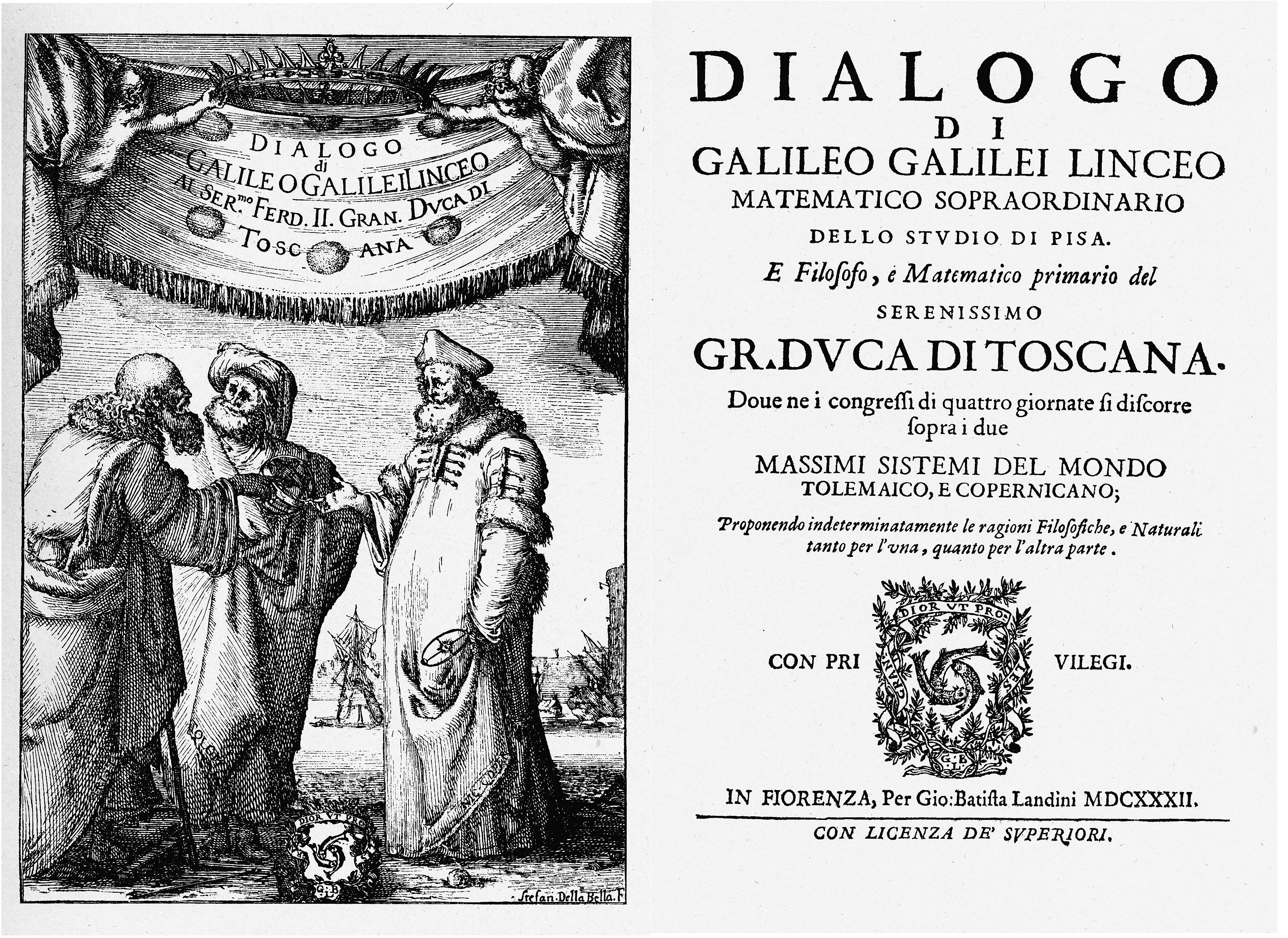
That proposition, of course, cannot be canonical without being ironic. Still, it is close enough to whatever the mark is by which we evaluate ideas. Think of it: On April 12, 1633, when Galileo Galilei was brought before his ecclesiastical inquisitors for defending the heliocentric theory of Copernicus, the grand defenders of the Holy Apostolic Truth were certain of his religious heresy and his scientific error. The secular science he proffered in his Dialogue on the Great World Systems(1632)did not square with Ecclesiastical Truth. Hence, he was tried.
Later, after he was convicted and facing the specter of prison,the Italian astronomer and philosopher reluctantly recanted and mouthed the words of a humiliating abjuration to the General Inquisitors against Heretical Depravity.Legend has it that somewhere along the way Galileo muttered a dissident phrase, “Eppur si muove!” — “And yet it moves!”
Meanwhile, the decree of the Congregation of the Indexprevailed, whereupon purist certainty returned to the bloody land.
Galileo did not follow the example of Socrates, who was forced to swallow the noxious certainty of his Athenian detractors. Facts aside, they, too, were convinced of the true identity of their gods and the Secret and Sacred Truths they espoused.
So it has been for centuries, no matter the nation, creed, or ideology. What well-functioning tyrannies and malfunctioning democracies have in common is some abiding commitment to certainty of one form or another. At some pinpoint in conceptual time, the former implodes into the latter, though it may take years to detect and even longer to concede. But by then it is too late, for certainty has taken its tragic toll. Oh, the evils that have been and continue to be committed — lives taken, torture inflicted, liberty deprived, and reputations smeared — in certainty’s name.
Beyond doubt
To say that one is certain is to say that something is beyond doubt. It is to say, for example, that the question under consideration is settled — it does not move anymore. “Moral certainty” adds an ethical or spiritual dollop of finality to the matter; it stills the need for discussion even more. In their unadulterated forms, monism, purism, absolutism, originalism, textualism, communism, liberalism, conservatism, atheism, and almost all other kinds of ism are akin to moral certainty — they are its secular cousins.
Where such “isms” rule over the minds of men and the wills of women,there is little room, if any, for movement in the opposite direction. They are Pavlovian words empty of content and meaning. When such words are triggered, any evil is possible — a fact exploited by authoritarian types. The inevitable result is censorship by the government’s formal decree or a group’s informal directive. Of course, the censor — even in the most tyrannical of regimes — always invokes some justification, some “higher good,” or some norm to rationalize or legitimize enforced silence. But whatever the justification, the followers of the Congregation of the Index demand their way.
Staying the censorial hand
The secular “gospel” of the First Amendment, by contrast, stays the censorial hand in ending discourse. As understood here, the Madisonian principle operates to move the vagaries of dialogue further along. In this sense, it is no faithful respecter of Truth with a capital T. Likewise, it is a foe to the dogmas of certitude preached by the Paters of Ism. Rather, the free speech frame of mind to which I refer invites Socratic gadfly types back into the city of dialogue from whence they were driven out. In other words, it allows the gods of the city to be challenged and the circularity of the heliocentricity of the sun to be defended. It leaves omniscience to the gods and everything short of that to mortals with enough will and determination to push Sisyphean stones.
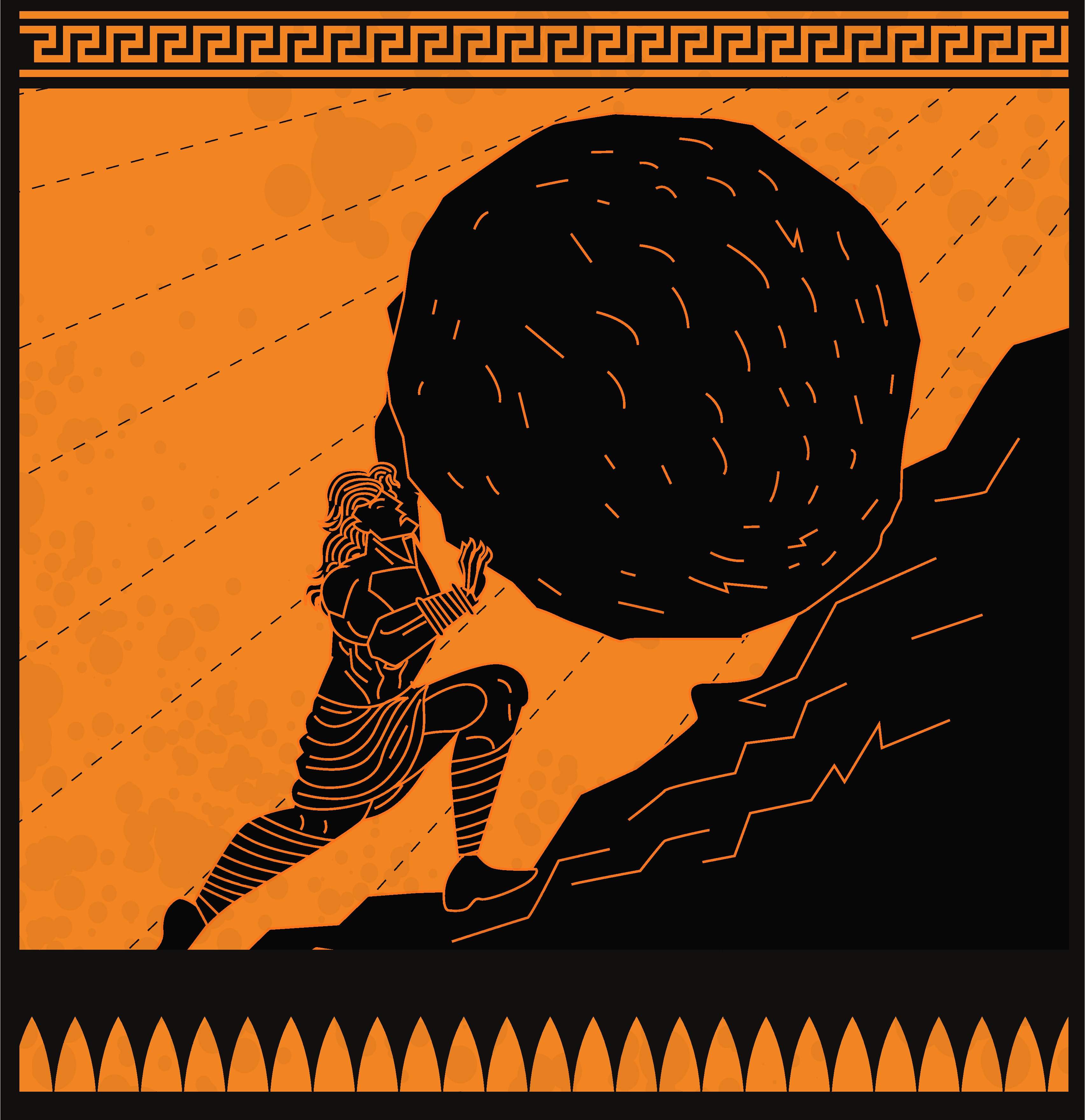
Sisyphus greek myth rolling a rock in a mountain. (Shutterstock.com)
Viewed in this light, the First Amendment both humbles and irritates us. It begs the nagging question, and then again, almost ad infinitum. In various ways — political and apolitical, civil and uncivil, scientific and unscientific, religious and secular — this way of acting disparages Darwin (and his critics), derides Derrida (and his opponents), and dismisses even the teachings of the great Dalai Lama (and his detractors). Why? There are many answers, but let me tender one, if only for preliminary consideration and examination.
Truth as a verb?
Start here: Truth might well be viewed more as a verb than a noun, more as a process than an end, and more incomplete than complete. Granted, gravity makes its demands, and cancer conquers many a cell. Admittedly, some degree of certainty is needed to live and survive. But in the long run, how we as humans come to understand such things is more an evolving cerebral matter than a static truth. We pay a price for certainty. Moreover, certainty has a way of becoming uncertain over time — the texture of truth never feels quite the same as one generation after another touches it.
Process (I do not say progress) is not a one-way ratchet. It does not always wrench towards truth, or improve life for the better, or explain things satisfactorily, or make the world more just, or more democratic, or more egalitarian, or coincide with our norms. Process, qua process, is indifferent to such values. It is no more normative than a hammer. To extend the metaphor, if in the name of the First Amendment we allow people to use such tools, we do so more in the blind hope that the resulting product will be more constructive than destructive. But who can be sure of how such matters will play out? By that calculus, this belief in the First Amendment asks us to trade certainty for contingency, and this with the uncertain expectation that something good may come of all of this. Those who oppose this contingent mindset often demand that the rest of us yield to their truths, that we abandon our doubts in the name of their convictions, and that we carve out ever more and more exceptions to the First Amendment, if only to make way for the norms which they are certain are central to any just society (or, should I say, to their view of such a society).
Mind you, I am not calling for a society free of values. My point is that such values exist in context and not in any caldron of categorical certainty. When the shine of glory fades over some heroes of the past, it is because the living are less certain of their greatness than their ancestors. Time allows us to see what their contemporaries either could not or would not see.
Humility born of doubt and the benefits of failure
Too often truth tumbles with hubris, with that smug audacity so confident of itself that it stands alone in the corner of the courtyard, deliberately distanced from the place where real ideas are exchanged. Its nemesis is a humility born of doubt about one’s own grasp of things, both epistemological and moral. We have made enough mistakes along the way to be able to benefit from the lessons that failure always has to teach.The benefits of failure, it should be noticed, come after the fact, after the proverbial damage has been done. Take, for example, the Pentagon Papers case,in which the government maintained that national security would be compromised and jeopardized if the leaks Daniel Ellsberg orchestrated and TheWashington Post and The New York Times sought to publish were made public.As it turned out, the government’s claim was exaggerated and unfounded.Thus, had the Court ruled other than it did, it would have sided with the “Government’s Truth” leaving the country to learn “from the lessons that failure has to teach.”
By contrast, the First Amendment as portrayed hereinmoves in the opposite direction. It prefers humility to hubris,dialogue to censorship, correction to certainty, some uncomfortable chaos to lockstep conformity, and the free flow of information to brash claims of secrecy, at least when there is no real, substantial, and imminent harm to be suffered. By that measure, such a First Amendment mindset is a modest one, a mind open to the actual possibility that it might be wrong in its claims of truth, in its assessment of the societal worth of a given form of expression, in its democratic calculation, in its moral evaluation, in its aesthetic judgment, or simply wrong in its starting premises. Such a view of things, of course, is not a cure-all. It is rather a process that, in the democratic scheme of things, errs on the side of more expression, not less, if only because it aspires to teach us all a few lessons this side of failure.
Bottom lines: Beware
of those who trade in absolutes,
of those certain of their certainty,
of those who have no tolerance for anyone with different views,
of those who demand the final word when it comes to anything from crime to cryptocurrencies,
of those who self-righteously preach patriotism or communism,
of those whose GOD is supreme over all other gods and gospels,
of those who champion “mob censorship” when it comes to views they dislike, and
of those who advocate the tactical worth of murder, either at home or abroad.
The governor of Texas just targeted a nonprofit over speech he doesn’t like.
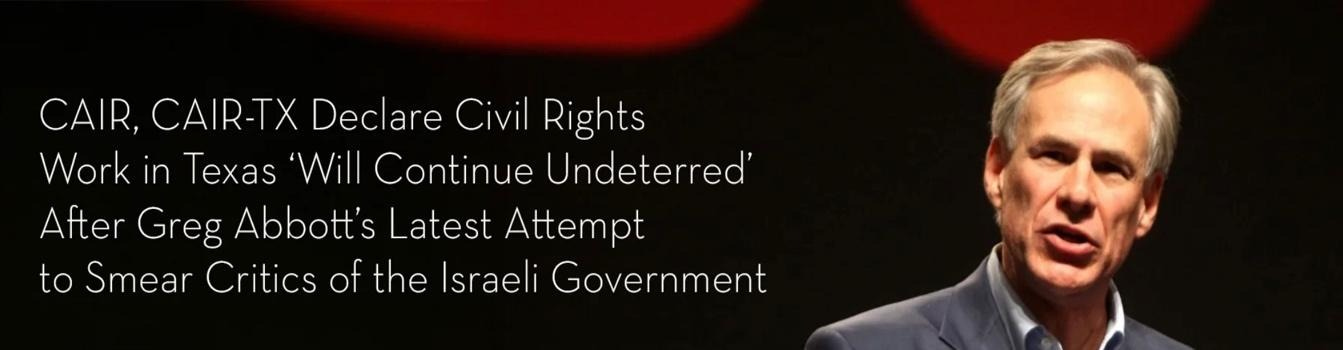
[Recently,] Texas Gov. Greg Abbott labeled the Council on American-Islamic Relations a foreign terrorist organization, and prohibited them from purchasing land in the state. That move doesn’t just have practical ramifications for CAIR’s ability to operate in Texas — it follows an all-too-familiar pattern in American history. In moments of perceived crisis, public officials cast unpopular ideological minorities as internal enemies, exploiting “security” concerns to trample on speech and belief.
CAIR is a D.C.-based, national organization whose mission is to “enhance understanding of Islam, protect civil rights, promote justice, and empower American Muslims.” CAIR has been fiercely critical of Israel and American efforts to support Israel’s military campaign in Gaza. Recently, CAIR successfully sued Abbott’s administration over executive orders that targeted pro-Palestinian campus protesters. CAIR also defended EPIC City, a Muslim-oriented development in Texas that Abbott investigated in September.
Against that backdrop, Abbott’s order designating CAIR cites to the organization’s protected speech and viewpoints, alleges that CAIR supports terrorism, and says they are “radical extremists” who “are not welcome in our state.” He then offers the vague assertion that CAIR wants “to forcibly impose Sharia law and establish Islam’s ‘mastership of the world.’” CAIR has since sued Abbott’s administration for the terror designation.
Using the language of “terrorism” and “foreign enemy” is not a new tactic to quash disfavored speech. In 1918, on the heels of World War I and the ensuing anti-German and anti-Bolshevik fervor, Montana passed its Sedition Act. The Act made it a crime to “utter, print, write or publish any disloyal, profane, violent, scurrilous, contemptuous, slurring or abusive language” about the U.S. government, Constitution, flag, military, or any language “calculated to incite or inflame resistance” to federal or state authority during the war. In other words, it made criticizing the U.S. illegal.
First Amendment Watch launches ‘SLAPP Back Initiative’
Findings from a new initiative at NYU, which tracks and analyzes strategic lawsuits against public participation
Courts dismissed dozens of strategic lawsuits against public participation targeting media in 2024, finds a new analysis from New York University’s First Amendment Watch. SLAPPs, often filed by corporations or deep-pocketed plaintiffs, are civil claims brought against individuals or organizations engaged in public expression and are seen by many as threats to free speech.
“Our initial findings make clear what observers have long suspected: the media are a significant target of potentially frivolous or malicious litigation designed to chill speech and stifle scrutiny,” says First Amendment Watch’s founding editor Stephen D. Solomon, whose team led the analysis. The analysis stems from a newly launched project housed at NYU’s Arthur L. Carter Journalism Institute: The SLAPP Back Initiative, the country’s first national database of SLAPP claims — potentially meritless legal actions that experts say can nonetheless force defendants to spend significant resources defending themselves, ultimately chilling criticism and threatening First Amendment freedoms.
The initiative’s analysis identified 500 cases that were decided on the merits of an anti-SLAPP motion last year, including 69 involving the media, most of which were either fully or partially dismissed by judges.
“These lawsuits affected every type of media entity across every medium at every level of the industry—from individual journalists and commentators to their publishers and sources,” says Solomon.
Viewpoint diversity is suddenly on everyone’s lips — yet few agree on what it really means. Is it about political balance? Free speech? Academic inclusion? Or something far more vital — the courage to engage across difference?
In Viewpoint Diversity: What It Is, Why We Need It, and How to Get It, leading heterodox thinkers tackle one of the most urgent questions of our time: how to keep open inquiry and constructive disagreement alive amid rising conformity on both left and right. Spanning essays on higher education, politics, culture, and the arts, this bold collection offers both sharp diagnosis and practical solutions for cultivating genuine pluralism.
Timely, provocative, and refreshingly constructive, Viewpoint Diversity makes the case for a richer, freer, and more resilient public culture — one that thrives not in spite of disagreement, but because of it.
So to Speak podcast on donor disclosure and political party contributions
The conversation also explores the broader landscape for political speech and campaign regulation, what legal battles may be next for the Supreme Court, and how both guests found their way into First Amendment advocacy.
This article is part of First Amendment News, an editorially independent publication edited by Ronald K. L. Collins and hosted by FIRE as part of our mission to educate the public about First Amendment issues. The opinions expressed are those of the article’s author(s) and do not necessarily reflect the opinions of FIRE.