


The First Amendment is not limited to the right to be right; it also enshrines the right to be wrong.
— Alan Dershowitz (Dec. 30, 1987)
Mindful of that spirited quote, consider the following recent statement by Jay Sekulow, attorney for the professor in Dershowitz v. Cable News Network (cert. petition, 2026):
The actual malice standard established in Sullivan, or as extended by its progeny, should be discarded altogether or at least as to private citizens who are public figures.
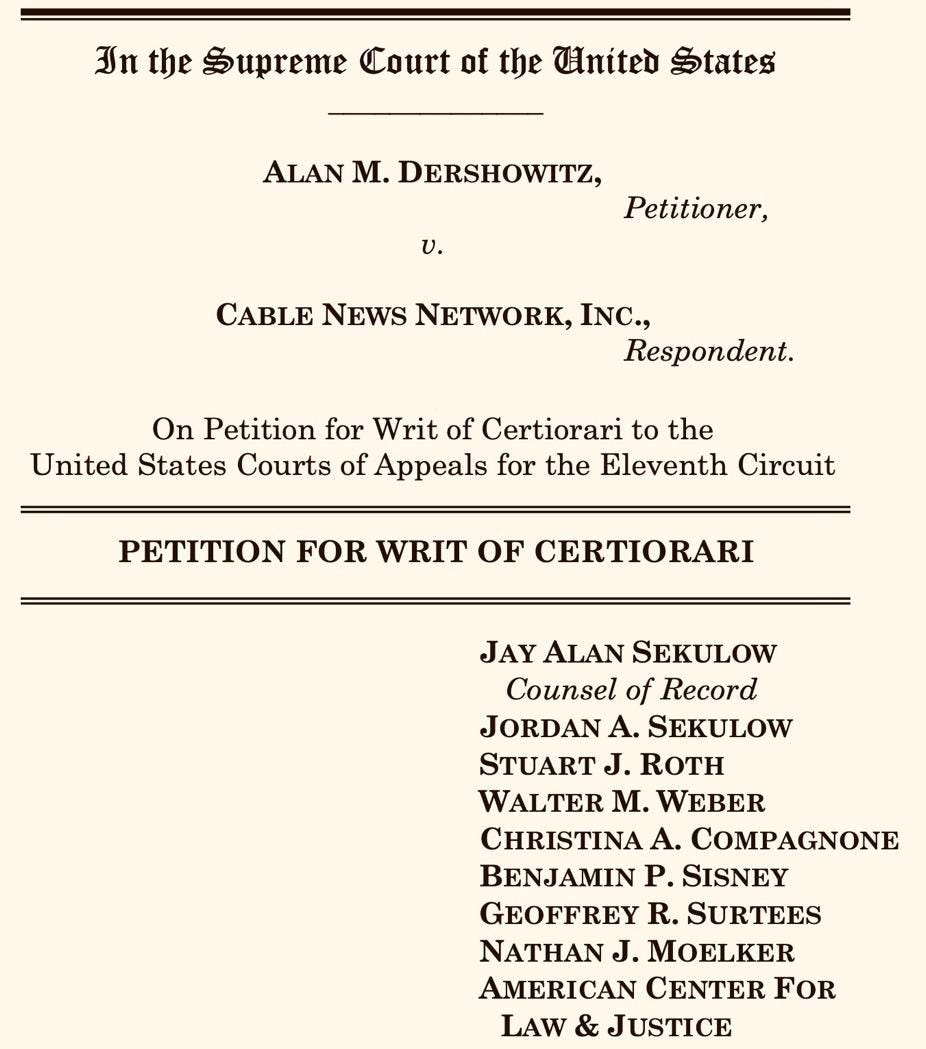
To be yet more explicit, Dershowitz’s lawyer urged the Justices to be bold:
This Court’s decision in New York Times Co. v. Sullivan constitutionalized, and revolutionized, defamation law in unwarranted, ahistorical, and ultimately harmful ways. Sullivan’s progeny extended that revolution further, exacerbating the cost for victims of defamation, especially public figures. This Court should either overrule Sullivan . . . or, as explained below . . . modify those aspects of Sullivan which aggravate the harms it inflicts on defamation plaintiffs.
As described by the Court of Appeals (11th Cir., 2025):
While representing President Donald J. Trump in impeachment proceedings before the Senate, law professor Alan Dershowitz gave a statement about the scope of impeachable offenses. That statement proved controversial, with many reporters and commentators characterizing it as out of bounds. Dershowitz now claims that CNN in particular, along with its on-air personalities, defamed him — intentionally misrepresenting his comments to tarnish his reputation.

The three-judge panel (with two Trump appointees) was unanimous in their judgment denying Professor Dershowitz’s defamation claims:
In his zealous and highly scrutinized representation, Dershowitz made a spontaneous series of remarks before Congress that, he says, were misinterpreted by pundits. But even if those commentators did report incorrectly on Dershowitz’s statements, he has offered no evidence that they did so intentionally. If anything, the evidence shows that they believed in the truth of their reporting, and that they formed their opinions independently. Without evidence of actual malice Dershowitz’s defamation claim cannot go forward, so we AFFIRM the district court’s grant of summary judgment to CNN.
That left but one main option: petition the Court to jettison Sullivan, which is what the Professor’s lawyers are doing.
1. Historical argument
Mr. Sekulow offered the following “originalist” argument:
The historical record is unequivocal: Sullivan’s actual malice standard has no basis in the Constitution’s original meaning. As Judge Lagoa observed, “Sullivan and its progeny are policy-driven decisions dressed up as constitutional law, and they find little — if any — support in our history.” From the Founding until Sullivan, defamation law operated under well-established common-law principles that applied equally to all plaintiffs, regardless of their public status. (Dun & Bradstreet, Inc. v. Greenmoss Builders, Inc., 472 U.S. 749, 765 (1985), White, J., concurring in judgment).
In the Founding era, it was well understood that the First Amendment did not abrogate the common law of defamation. Scholars and jurists agreed that even public officials could sue for libel “upon the same footing with a private individual” because “[t]he character of every man should be deemed equally sacred, and of consequence entitled to equal remedy.” (Tunis Wortman, A Treatise, Concerning Political Enquiry, and the Liberty of the Press 259 (New York George Forman, ed., 1800)). State courts were “open to all persons alike” for “redress for any false aspersion on their respective characters, nor is there any thing in our laws or constitution which abridges this right.” (St. George Tucker, View of the Constitution of the United States with Selected Writings 237-38 (Clyde N. Wilson, ed., 1999) (1803)). Authorities universally agreed that the First Amendment was never intended to immunize defamatory falsehoods.
2. Policy argument
The next major argument tendered by Mr. Sekulow is as follows:
Sullivan’s departure from history would be troubling enough on its own terms. But Sullivan’s problems run deeper still. The decision misread the historical sources without meaningfully engaging with them at all. Instead, Sullivan represents “policy-driven decisions masquerading as constitutional law.” (McKee v. Cosby, 586 U.S. 1172, 1173 (2019) (Thomas, J., concurring in denial of certiorari)). Sullivan “overturn[ed] 200 years of libel law.” (Dun & Bradstreet, Inc., 472 U.S. at 766 (White, J., concurring in the judgment)). Indeed, this Court has since acknowledged that “the rule enunciated in the New York Times case . . . is . . . largely a judge-made rule of law,” which “is not revealed simply by its literal text, but rather is given meaning through the evolutionary process of common-law adjudication.” (Bose Corp. v. Consumers Union of U.S., Inc., 466 U.S. 485, 501-02 (1984)).
3. Limiting Sullivan to public officials
Whatever arguments might exist for special protections for criticism of government officials do not extend to private citizens who happen to achieve prominence. The distinction matters profoundly and was disregarded by this Court when it extended Sullivan to public figures in Time, Inc. v. Hill, 385 U.S. 374 (1967), and Gertz. Sullivan was motivated by a desire to protect public criticism of official conduct and actions of public officials. Sullivan, 376 U.S. at 282. In fact, the Sullivan Court relied on the common law privilege that protected criticism of public officials, id. (citing Coleman v. Maclennan, 78 Kan. 711 (1908)), and explicitly developed a “privilege for the citizen-critic of government,” id. But then, in Hill, the Court disregarded this reasoning, extending the Sullivan rule to any public figure.

4. Changing the evidentiary standard and burden of proof standard
Sullivan imposed not one but two burdens on public-figure plaintiffs: a substantive requirement (actual malice) and a heightened evidentiary standard that requires the plaintiff to show not merely falsity but actual malice, and to do so with “the convincing clarity which the constitutional standard demands.” (Sullivan, 376 U.S. at 285-86). This double hurdle has become virtually insurmountable, with the Sullivan standard thereby “protecting lies — by insulating those who spread them behind an iron barrier,” (App. 24a (Lagoa, J., concurring)). These hurdles should be reconsidered.
5. The stare decisis argument
The Court has repeatedly emphasized that stare decisis carries less weight for constitutional decisions that Congress cannot correct through legislation. (Gamble v. United States, 587 U.S. 678, 691 (2019)). For a century and a half, states regulated defamation according to common law principles. Sullivan revolutionized this field without substantial constitutional foundation. When this Court errs in interpreting the Constitution — particularly when it concocts a constitutional rule with no anchor in the document’s text or history — only this Court can correct the error. If stare decisis did not bind the Sullivan Court when it upended centuries of settled law, it does not prevent correction now.
Related resources
Angel Eduardo, “What the First Amendment Is For,” Law & Liberty (Nov. 6, 2024)
Ronald K.L. Collins, “Review essay: Handman and Feder on Barbas’ ‘Actual Malice’ — A new look at NYT v. Sullivan,” First Amendment News 375,” (April 12, 2023)
Lee Rawles and Samantha Barbas, “Why NYT v. Sullivan mattered in 1964 and is under attack today,” Modern Law Library Podcast, (March 29, 2023)
Angel Eduardo, “Why New York Times v. Sullivan matters more than ever,” FIRE (March 7, 2023)
“New York Times v. Sullivan: The Case for Preserving an Essential Precedent,” Media Law Resource Center (March 2022) (contributors: Floyd Abrams, Matthew Schafer, Richard Tofel and Jeremy Kutner, Michael Norwick, Ballard Spahr, LLP, and Davis Wright Tremaine, LLP, David Heller and Katharine Larsen, and Lee Levine)
Ronald K.L. Collins, “Bruce Johnson responds to Judge Laurence Silberman’s attack on NYT v. Sullivan,” First Amendment News (March 24, 2021)
Ronald K.L. Collins, “Contra-Justice Thomas, the originalist debate continues — a review of Wendell Bird’s ‘Criminal Dissent’,” First Amendment News 277 (Nov. 11, 2020)
Ronald K.L. Collins, “Justice Thomas urges Court to pare back Section 230’s ‘sweeping immunity’,” First Amendment News 275 (Oct. 21, 2020)
Ronald K.L. Collins, “More on originalism and the First Amendment, enter Matthew Schafer,” First Amendment News 274 (Oct. 7, 2020)
Ronald K.L. Collins, “Ian Millhiser on Justice Thomas’s maverick views on modern free speech jurisprudence,” First Amendment News 254 (May 13, 2020)
Ronald K.L. Collins, “Levine and Wermiel: Dubious Doubts and ‘the Central Meaning of the First Amendment’—A Preliminary Reply to Justice Thomas,” First Amendment News 202.1 (March 1, 2019)
Steve Vladeck, “Trump’s attacks on the First Amendment and the press gain an ally in Supreme Court Justice Clarence Thomas,” NBC News (Feb. 20, 2019)
Trump defamation suit against the BBC
“The BBC Seeks To Dismiss Trump’s $10B Defamation Lawsuit in a Florida Court,” First Amendment Watch (Jan. 13)
The BBC plans to ask a court to throw out U.S. President Donald Trump’s $10 billion lawsuit against the British broadcaster, court papers show.
Trump filed a lawsuit in December over the way the BBC edited a speech he gave on Jan. 6, 2021. The claim, filed in a Florida federal court, seeks $5 billion in damages for defamation and $5 billion for unfair trade practices.
The speech took place before some of Trump’s supporters stormed the U.S. Capitol as Congress was poised to certify President-elect Joe Biden’s victory in the 2020 election that Trump falsely alleged was stolen from him.
The BBC had broadcast the documentary — titled “Trump: A Second Chance?” — days before the 2024 U.S. presidential election. It spliced together three quotes from two sections of the 2021 speech, delivered almost an hour apart, into what appeared to be one quote in which Trump urged supporters to march with him and “fight like hell.” Among the parts cut out was a section where Trump said he wanted supporters to demonstrate peacefully.
The broadcaster has apologized to Trump over the edit of the Jan. 6 speech. But the publicly funded BBC rejects claims it defamed him. The furor triggered the resignations of the BBC’s top executive and its head of news.
Papers filed Monday in U.S. District Court in Miami say the BBC will file a motion to dismiss the case on March 17 on the basis that the court lacks jurisdiction and Trump failed to state a claim.
Teaching Plato can be dangerous to a professor’s career
“Texas A&M to philosophy professor: Nix Plato or be reassigned,” FIRE (Jan. 7)
Just weeks ago, FIRE warned that A&M policy banning professors from teaching issues of “race or gender ideology” and “sexual orientation” in core courses violates faculty academic freedom. The First Amendment prohibits public universities from deciding which viewpoints can be taught in a classroom, and which must be banished.
The following can be attributed to Lindsie Rank, director of Campus Rights Advocacy at FIRE.
“Texas A&M now believes Plato doesn’t belong in an introductory philosophy course. The philosophy department is demanding that professor Martin Peterson remove Platonic readings because they “may” touch on race or gender ideology. He’s been given until the end of the day to comply or be reassigned. This is what happens when the board of regents gives university bureaucrats veto power over academic content. The board didn’t just invite censorship, they unleashed it with immediate and predictable consequences. You don’t protect students by banning 2,400-year-old philosophy.”
Related
Greg Lukianoff, “If You Can’t Teach Plato in a Philosophy Class, What Can You Teach?” The New York Times (Jan. 12)
First Amendment advocates often warn about a slippery slope. Once censorship starts at the margins, core freedoms are next. In Texas, university administrators and state commissars are skipping the slope and going straight for the trap door.
Emma Whitford, “Plato Censored as Texas A&M Carries Out Course Review,” Inside Higher Education (Jan. 7)
At least 200 courses in the Texas A&M University College of Arts and Sciences have been flagged or canceled by university leaders for gender- or race-related content as the university undertakes its review of all course syllabi, faculty members told Inside Higher Ed.
This is just the beginning of the system board-mandated course-review process. Faculty were required to submit core-curriculum syllabi for review in December, and some faculty members have yet to receive feedback on their spring courses, scheduled to begin Monday. So far, queer filmmakers, feminist writers and even ancient Western philosophers are on the chopping block.
One faculty member — philosophy professor Martin Peterson, who is supposed to teach Contemporary Moral Problems this spring — was asked by university leadership to remove several passages by Plato from his syllabus. . . .
A fresco taken from the north wall of the Tomb of the Diver(from Paestum, Italy, c. 475 BC): a symposium scene
The Plato texts include passages from his Socratic dialogue Symposium that discuss patriarchy, masculinity, gender identity and the human condition. In one excerpt, the “Myth of the Androgyne,” the Greek playwright Aristophanes says, “First, you should learn the nature of humanity … for in the first place there were three kinds of human being and not two as nowadays, male and female. No, there was also a third kind, a combination of both genders.”
Tim Zick, “Backsliding on Academic Freedom,” Thoughts on the First (Jan. 9)
Job Opening: Institute for Free Speech seeks its next president
The Institute for Free Speech — the nation’s only organization dedicated solely to defending political speech rights — is seeking a visionary leader to serve as its next president. This is an exceptional opportunity to lead a thriving organization at the forefront of First Amendment advocacy. The position opens as current President David Keating, after 14 distinguished years of leadership, transitions to a policy-focused role. David will continue as president until his successor is named, ensuring seamless continuity for the organization.

Now, we’re looking for the ideal candidate to lead the Institute for the next decade-plus. The new president will inherit a healthy budget and a talented team committed to protecting our rights to freely speak, assemble, publish, and petition the government. This deliberate, careful search reflects our commitment to finding the right person to guide the Institute through its next chapter of growth and impact. To learn more about the position, please click here.
Go here for job description and requirements.
FIRE documentary on deporting students
In 2025, the second Trump administration — led by Secretary of State Marco Rubio — began using a McCarthy-era law to revoke student visas for noncitizens expressing pro-Palestinian views. This raises an urgent question on the state of free speech in the United States: Do noncitizens have First Amendment rights in the U.S.?
FIRE’s new series, “1AX,” exposes the front lines of America’s free speech battles, where dissent is challenged, rights are tested, and the Constitution itself is put on trial. In this episode on free speech and immigration, FIRE asks: How far will the government go to silence dissent?
Forthcoming book on antisemitism and free speech
James Loeffler, “Exceptional Hatred: Antisemitism and the Fight over Free Speech in Modern America,” Metropolitan Books (Aug. 2026)
A leading historian’s revelatory exploration of antisemitism in the United States ― from 1940s anti-Jewish riots until today ― showing that it has long served as a frontline in our wars over freedom of speech and the nature of American liberalism

Few issues are as vexed today as antisemitism and free speech. There is scarcely an arena ― college campuses, congressional hearings, immigration courtrooms, social media platforms―where we are not polarized over what counts as antisemitism, which speech is protected by the First Amendment, and what the law should do about hatred. At a time of political crisis, antisemitism has become a point of ideological obsession.
None of this is new. In a sweeping history of ideas and law, James Loeffler recovers the forgotten roots of our contemporary turmoil. From two antisemitic riots in postwar Chicago to a neo-Nazi march in 1970s Skokie, Illinois, and the Charlottesville Unite the Right rally in our own time, Loeffler explores the ways in which America’s courts have grappled with hatred, freedom, and the tensions at the heart of liberal democracy: Are some hatreds more dangerous than others? Is tolerating hate speech the price we must pay for free speech? And can liberalism ever make good on its promise to end hatred through law?
Confronting these questions, Exceptional Hatred restores a missing history of hate speech, antisemitism, and the law, one that points to how we might protect difference without surrendering our principles of equality and freedom.
New book on ‘annoying speech’ and criminal prosecution
Raphael Golb, “When Speech Becomes a Crime,” (2025)
“You’re under arrest,” said the policeman pointing a gun at Raphael Golb’s face. “It’s about the Dead Sea Scrolls.”
On March 5, 2009, Golb, a lawyer practicing in New York, had his computer seized — and his future.
This book tells the inside story of how prosecutors sought — in a case that lasted nine years — to have Golb imprisoned for engaging in “annoying” speech. Reflecting on the various court decisions elicited by the case, Golb poses the crucial question of where the United States today stands regarding a pillar of American democracy: the First Amendment.
Will forms of expression that stir up controversy again be suppressed, as they were in centuries past? Or will the courts decisively recognize that provocative ways of challenging power must be protected, even when they take us out of our comfort zone?
In sum, will the First Amendment remain the guiding star of our democracy, or has it become a political football, tossed between left and right, at times enforced, at other times ignored or evaded?
Speech has been criminalized through the centuries. But the latest efforts to suppress it, Golb says, must be seen in the context of issues increasingly relevant to our time: the growth of spectacle at the expense of debate; hidden patterns of censorship; the ease with which authority can be abused in a democratic society — and many more.
More in the news
Eugene Volokh, “Free Speech Unmuted: 2025: The Year in Free Speech,” The Volokh Conspiracy (Jan. 12)
Alan S. Lewis and Madelyn K. White, “New York’s Anti-SLAPP Act: An Unnecessary Chill on the First Amendment Right to Petition,” New York Law Journal (Jan. 12)
Colin Kalmbacher, “‘At issue is the public right of access’: First Amendment group savages Mar-a-Lago judge for ‘incorrect’ ruling over Jack Smith report, urges appeals court to quickly reverse,” Law & Crime (Jan. 10)
Jacob Gaba, “Can the Pentagon strip Mark Kelly’s rank over speech?” FIRE (Jan. 9)
“Tennessee University Reinstates Professor Fired for Charlie Kirk Post and Settles for $500K,” First Amendment Watch (Jan. 9)
Josh Gerstein, “Court throws out Sept.11-era convictions on First Amendment grounds,” Politico (Jan. 9)
“Jack Smith would have blown a hole in the First Amendment,” The Washington Post (Jan. 9)
“Texas Cracked Down on Teachers for Posts About Charlie Kirk, Union Lawsuit Says,” First Amendment Watch (Jan. 7)
2025-2026 SCOTUS term: Free expression and related cases
Review granted
Chiles v. Salazar (argued: Oct. 7)
Olivier v. Brandon (argued: Dec. 3)
First Choice Women’s Resource Centers, Inc. v. Platkin (argued: Dec. 2)
National Republican Senatorial Committee v. Federal Election Commission (argued: Dec. 9)
Pending petitions
Dershowitz v. Cable News Network
360 Virtual Drone Services LLC v Ritter
Emergency docket (‘Shadow docket’)
Margolin v. National Association of Immigration Judges (application for a stay denied)
Chamber of Commerce v. Sanchez (application withdrawn)
Free-speech related
Trump v. Carroll (Federal Rules of Evidence speech-related case)
Olivier v. City of Brandon, Mississippi (Whether this court’s decision in Heck v. Humphrey bars claims under 42 U.S.C. § 1983 seeking purely prospective relief where the plaintiff has been punished before under the law challenged as unconstitutional; and (2) whether Heck v. Humphrey bars Section 1983 claims by plaintiffs even where they never had access to federal habeas relief.)
Petitions denied
Cambridge Christian School, Inc. v. Florida High School Athletic Association, Inc.
Hartzell v. Marana Unified School District
Evans Hotels, LLC v. Unite Here! Local 30
Last Scheduled FAN
Book review: ‘Trump 2.0: Executive Power and the First Amendment’

In what follows, Stephen Rohde offers a review essay of Professor Timothy Zick’s recently released book, Trump 2.0: Executive Power and the First Amendment (Carolina Academic Press, 2026). It is the first review of the book, and I’m grateful to Mr. Rohde for his prompt and thoughtful reflections.
This article is part of First Amendment News, an editorially independent publication edited by Ronald K. L. Collins and hosted by FIRE as part of our mission to educate the public about First Amendment issues. The opinions expressed are those of the article’s author(s) and do not necessarily reflect the opinions of FIRE.
Give it up, Al. You are looking like your pal Donffrey Trumpstein (both of them). When confronted with evidence of guilt, go on the attack. Roy Cohn teach you that too?