This is a defining moment in our nation’s history. Your skills, your experience, and your courage have never been more essential. Together, we must defend the homeland.
Sometimes the tragic masquerades as comic, if only because what was once seen as surreal is accepted as ordinary. In the process, truth is left to fend for itself and liberty is lost to autocracy. Power becomes an end in itself; untruths pose as truth; meaning collapses into meaninglessness; and anyone who says otherwise is a traitor, a domestic terrorist. There is no measure of restraint, no check on power. There is only the restraint that comes with those subject to detention, brutality, or even death. It is the spectacle of our times.
Standard ICE procedure: Unlawful detentions, systemic abuse, provocative behavior, and short-tempered responses to protesters. Meanwhile, the tongues of many remain silent. In this corridor of complicity, government officials robotically echo the words of their authoritarian master; their media counterpartsamplify the falsehoods of the echo chamber.
It is all a part of living in an ICE age — the age of Trump tyranny.
The federal government recruited them for a domestic “wartime recruitment” campaign. Military enthusiasts, gun slingers, and NASCAR fans were all enlisted to do combat with “domestic terrorists.” A rapid hiring spree, characterized by compressed timelines and shortened training periods, is so fast that it sometimes forgoes background checks. Once hired, their garb is military, replete with gaiter-style masks, tear gas, rubber bullets, pepper balls, 9mm Lugers, and Glock 19s. They quell disturbances (including peaceful protests). Their menacing presence and brute-force mindsets instigate the very disturbances they are said to prevent. And when they kill people (e.g., Renee Nicole Good), their actions are justified by claims that they were “violently, willfully, and viciously” attacked by “domestic terrorists.”
And then there is the infamous Homeland Security Secretary, Kristi Noem. Clad in her wide cowboy hat, fatigues, and long earrings, she gave her quick-draw justification of the Minneapolis ICE shooting that left a mother of three dead from point-blank shots to her head. Her remarks were absurd, irresponsible, and rash. But no matter; she must toe her boss’s line — attack the victim: “[T]he facts are that this individual weaponized her car and threatened the life of the law enforcement officer and those around him.”
And then to add more ammunition to the “weaponized” charge, there was an attack on the victim’s character. From Jarvis DeBerry’s Jan. 16 piece, “Trump’s latest smear of Renee Good,” in MS Now:
Federal government officials, including President Donald Trump, immediately labeled Good, a 37-year-old wife and mother, a “violent rioter” and a “domestic terrorist” after Immigration and Customs Enforcement officer Jonathan Ross shot her dead on Wednesday, Jan. 7. Then, on Sunday, Trump called Good and her wife, Becca Good, “professional agitators.” He said his administration would “find out who’s paying for” such protests. On Monday, The New York Times, citing people familiar with the situation, reported that federal officials are looking into the Goods’ ties to activist groups.
Now, the Pentagon is busy preparing 1,500 troops for a potential deployment to Minnesota to combat protests. As if that were not enough, Trump is now threatening to invoke the Insurrection Act which, he claims, would allow him to deploy the military to police the protests.
“The Constitution, our civil laws, regulations, mores, customs, practices, courtesies — all of it; the President simply ignores it all when he takes it into his head to act.”
“Behold President Trump’s successes in limiting free speech — law firms cower, institutional leaders in higher education meekly appease the President, media outlets from huge conglomerates to small niche magazines mind the bottom line rather than the ethics of journalism.”
“He meets dissent from his orders in those other two branches by demonizing and disparaging the speakers, sometimes descending to personal vitriol.”
“Dissent elsewhere among our people is likewise disfavored, often in colorful scurrilous terms.”
A recent 83-page opinion by U.S. District Judge Katherine Menendez features shocking details of ICE agents’ abuses. Here are a few sample passages, which is well worth reading in full:
[Observing and recording ICE agents]: Plaintiffs assert that they engaged in the following protected activity: assembling in public to protest ICE actions and activity; observing ICE officers who are engaged in their official duties in public, including by following ICE vehicles; and recording and disseminating videos of ICE agents they observe. While Defendants do not dispute that expressing disapproval of ICE operations is protected speech, they challenge whether Plaintiffs’ specific actions of observing, recording, and following ICE officers in the performance of their duties are protected by the First Amendment.
[T]his Court notes that every other Court of Appeals to have considered the issue has found that the First Amendment protects a right to peacefully observe and/or record law enforcement officers who are engaged in their official duties in public.
[Probable cause for arresting protesters?]: Defendants argue that Ms. [Susan] Tincher cannot show retaliatory animus because the ICE officers who arrested her had at least a reasonable, if mistaken, belief that there was probable cause to arrest her for a violation of 18 U.S.C. § 111.29 The Court disagrees. . . [A]t this stage, the Court finds Ms. Tincher has a likelihood of success on showing causation on her First Amendment retaliation claim.
[Moreover,] at no time can [Mr. Abdikadir] Noor be seen physically interfering with the agents, nor threatening them. Furthermore, in the moments leading up to his arrest, it is Noor who is pushed by an agent, after which he backs well away from the officers and their squad car, only for them to step forward to detain him. On this record, there is no basis to conclude that officers had even mistaken probable cause to place him under arrest. The Court finds that Mr. Noor is likely to succeed on the merits of his claim that he was arrested in retaliation for engaging in protected First Amendment activity.
[Use of chemical irritants against peaceful protester]: Video evidence submitted by the parties supports this conclusion. It appears that the officers who deployed the chemical irritant did so though Mr. Crenshaw was not obstructing ICE vehicles that were trying to leave. Taken together, the evidence sufficiently supports that Mr. Crenshaw has a fair chance of prevailing on his First Amendment retaliation claim.
In Tincher v. Noem (Jan. 16) the District Court ordered the designated federal agents to adhere to the following admonitions:
Covered Federal Agents are hereby enjoined from:
a. Retaliating against persons who are engaging in peaceful and unobstructive protest activity, including observing the activities of Operation Metro Surge.
b. Arresting or detaining persons who are engaging in peaceful and unobstructive protest activity, including observing the activities of Operation Metro Surge, in retaliation for their protected conduct and absent a showing of probable cause or reasonable suspicion that the person has committed a crime or is obstructing or interfering with the activities of Covered Federal Officers.
c. Using pepper-spray or similar nonlethal munitions and crowd dispersal tools against persons who are engaging in peaceful and unobstructive protest activity, including observing the activities of Operation Metro Surge, in retaliation for their protected conduct.
d. Stopping or detaining drivers and passengers in vehicles where there is no reasonable articulable suspicion that they are forcibly obstructing or interfering with Covered Federal Agents, or otherwise violating 18 U.S.C. § 111. The act of safely following Covered Federal Agents at an appropriate distance does not, by itself, create reasonable suspicion to justify a vehicle stop.
‘Talking straight’: Trump’s passion for revenge
When somebody gets you, you want to get them. . . . I do believe in retribution.
Where things run off the rails for him is his fixation with “retribution.”
“I am your retribution,” he thundered famously while on the campaign trail. Yet government retribution for speech (precisely what has happened here) is directly forbidden by the First Amendment.
Whatever else the First Amendment stands for, it is axiomatic that its toleration principle cannot countenance revenge orchestrated by government officials. The central purpose of the Madisonian guarantee was to put an end to such political revenge and to provide a safe harbor for opposing views.
Donald Trump spoke the above words more than a quarter of a century ago on The Tonight Show with Jay Leno. In time, his personal beliefs became his political creed, executed by his cabinet underlings and others. It explains why he’s used his political might to go after the likes of:
Former FBI Director James Comey
Federal Reserve Chair Jerome Powell
Former CIA Director John Brennan
New York Attorney General Letitia James
Several career DOJ employees (e.g., Michael Ben’Ary and Erez Reuven)
Jack Smith and those who worked with him
Senator Mark Kelly (Dem.)
Senator Adam Schiff (Dem.)
Congressman Eric Swalwell (Dem.)
Former director of the Cybersecurity and Infrastructure Security Agency, Christopher Krebs, and many others
The American people have witnessed the previous administration engage in a systematic campaign against its perceived political opponents, weaponizing the legal force of numerous Federal law enforcement agencies and the Intelligence Community against those perceived political opponents in the form of investigations, prosecutions, civil enforcement actions, and other related actions. These actions appear oriented more toward inflicting political pain than toward pursuing actual justice or legitimate governmental objectives.
In that same executive order, he called for an end to the “weaponization of the federal government.”
Of course, duplicity, and not honesty, has long been his endgame.
Justice Samuel A. Alito elaborates on his judicial philosophy and reflects on the roles of the law, the Constitution, and the courts in preserving America’s spirit of liberty.
Samuel A. Alito has quietly become one of the most influential Supreme Court justices in recent history. In this surprisingly personal book, he vigorously defends his “originalist” approach to the Constitution, identifies the threats to our liberties, and reflects on faith, the nature of law, and American culture. Twenty years on the high court have given Justice Alito a unique perspective on the country’s fiercest legal and constitutional battles. As America’s culture wars unfolded, one side harnessed the power of the judiciary to impose its agenda, abetted by judges scornful of constitutional constraints and untroubled by doubts about their own infallibility. The response was a legal movement devoted to originalism and textualism, which found its most effective champion in Justice Alito. The battles, of course, are far from over. Free speech and religion, in particular, are frequently under fire. Justice Alito offers a compelling vision of the courts’ role in defending these and other fundamental liberties. In So Ordered, one of our greatest jurists celebrates the complexity and brilliance of the American Constitution.
Protest! Respect It Defend It Use It offers a powerful look at the role peaceful activism has played in advancing the public good — and shines a light on the urgent need to protect this democratic right. This is not a how-to guide. Rather, it is a celebration of what collective action can achieve, an invitation to be inspired, and a reminder that each of us has the capacity to make a difference.
Featuring more than 40 iconic campaigns from around the world, the book combines photos, artifacts, and memorable quotes to create a vivid testament to the power of public dissent. Guest essays from Jane Fonda, Tennessee Representative Justin Pearson, Dolores Huerta, Nemonte Nenquimo, and others reveal how protest shaped their own commitment to driving change. Through storytelling and first-hand reflection, readers are invited to witness, reflect, and engage in peaceful activism—right here, right now.
Rivers that don’t catch fire. The freedom to marry whom we love. Clean air and water. Even weekends off. Peaceful protest — protected in the U.S., as in many countries, as a cornerstone of participatory democracy — helped bring about each of these victories. Free speech, dissent, and public mobilization are essential tools for advancing so many causes, including environmental protection, workers’ rights, human rights, self-determination, and climate, social, and racial justice.
Yet even as protest has delivered lasting progress — and perhaps because of it — the right to speak freely and organize is increasingly under threat. Crackdowns are no longer confined to authoritarian regimes; anti-protest sentiment is spreading across established democracies. Activists are being vilified, targeted, and even criminalized. In the U.S., anti-protest laws have been enacted in 49 states. SLAPP suits — meritless legal actions used to silence dissent — are on the rise. New legal concepts like “negligent protest” are being used to hold organizers liable for damages, while violent actions by anti-democratic forces are reframed or excused.
Published to coincide with the 250th anniversary of one of history’s most consequential acts of protest — the signing of the Declaration of Independence — this book is an invitation. It invites readers to learn about the creativity, courage, and impact of peaceful protest, to be inspired by those who came before, and to recognize that this essential democratic right belongs to everyone — now more than ever.
Thomas Paine arrived in America in 1774 with little to his name and a long record of personal failure behind him. Within a year, he wrote Common Sense, one of the most influential political pamphlets in history, helping to ignite the American Revolution and catapulting Paine into the American history hall of fame.
But by the end of his life, he was widely reviled, politically isolated, and personally abandoned. Once celebrated as the voice of liberty, he died an outcast, mourned by only six people at his funeral.
How does one man become the voice of the American Revolution and end up forgotten? To explore Paine’s complicated legacy, we are joined by Richard Bell, professor of history at the University of Maryland and author of The American Revolution and the Fate of the World.
Related
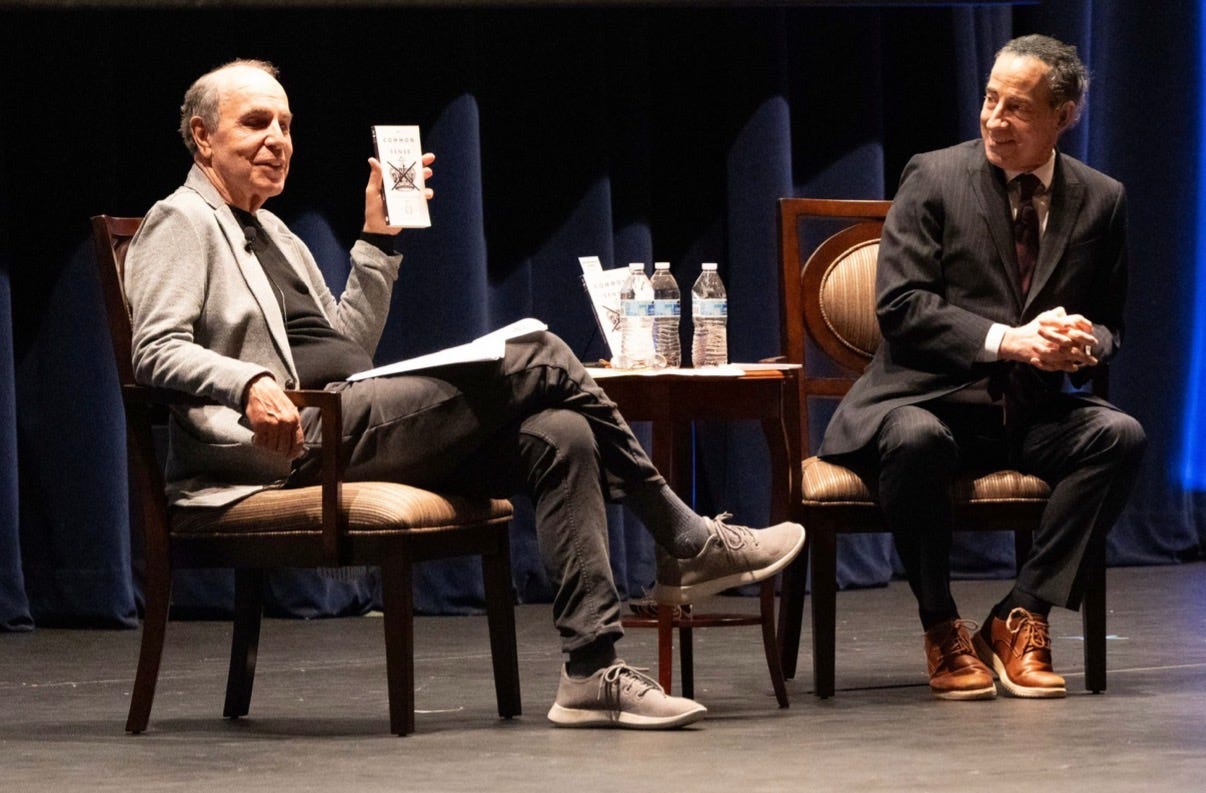
Jan. 10: with Congressman Jamie Raskin celebrating the 250th anniversary of Common Sense
Trump v. Carroll (Federal Rules of Evidence speech-related case)
Olivier v. City of Brandon, Mississippi (Whether this court’s decision in Heck v. Humphrey bars claims under 42 U.S.C. § 1983 seeking purely prospective relief where the plaintiff has been punished before under the law challenged as unconstitutional; and (2) whether Heck v. Humphrey bars Section 1983 claims by plaintiffs even where they never had access to federal habeas relief.)
This article is part of First Amendment News, an editorially independent publication edited by Ronald K. L. Collins and hosted by FIRE as part of our mission to educate the public about First Amendment issues. The opinions expressed are those of the article’s author(s) and do not necessarily reflect the opinions of FIRE.